Pongal explained for kids: the harvest festival of thanks
This guide is for parents who want to explain Pongal to a young child, whether your family celebrates it or you are joining Tamil friends and neighbours. You will find the idea in simple words, the four days of the festival, and easy things to try at home.
The idea in one breath
Pongal is a harvest and thanksgiving festival, celebrated mainly by the Tamil community. It usually falls on 14 or 15 January, at the start of the Tamil month of Thai, so in 2027 it arrives in the middle of January.
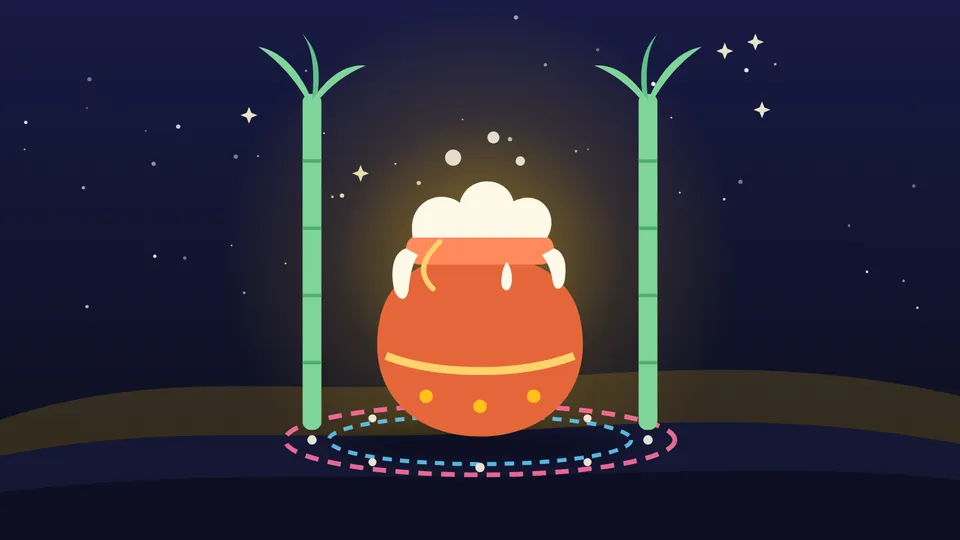
Say it simply "Pongal is a thank-you festival. Families cook sweet rice and milk in a pot until it bubbles over, and say thank you to the sun, to nature and to the animals that help grow our food."
The word Pongal comes from Tamil and means to boil over. The overflowing pot is the heart of the festival: it stands for plenty and good fortune in the year ahead.
The four days
- Bhogi Pongal The day for tidying the home and clearing out old things, ready for a fresh start.
- Thai Pongal The main day. Fresh rice is cooked with milk and sugar, often in a clay pot, as an offering to Surya, the sun.
- Mattu Pongal A day to honour cattle, who help on farms. They are decorated with paint, flowers and bells, and fed sweet rice and sugarcane.
- Kaanum Pongal A day for visiting relatives and friends, when younger family members seek the blessings of their elders.
Did you know? When the milk boils over, families call out "Pongalo Pongal!" And visitors may ask a friendly question, "Paal pongitha?", which means "Has the milk boiled over in your house?" (NLB Infopedia).
Pongal in Singapore
Pongal is not a public holiday in Singapore, so many families keep it on one main day around school and work. In flats, the pot is usually boiled on the kitchen stove rather than over an outdoor fire. Here is what your child might notice:
- Kolam at the door Colourful floor patterns drawn at the entrances of homes and temples.
- Sugarcane Tall stalks of sugarcane, offered at prayers and sold in Little India before the festival.
- Little India Stalls with festive goods, street light-ups along Serangoon Road, and in some years cows brought in so visitors can learn why cattle matter.
- Community events The Indian Heritage Centre and Little India groups run family programmes, and some community centres hold celebrations too. Check their pages nearer the date.
Things to try at home
0 of 5 done
Questions children ask
Why do they want the pot to spill over?
At Pongal, spilling over is a happy sign that there will be more than enough in the new year, so families cheer.
Why do cows get a special day?
On farms, cattle help plough the fields, so the harvest depends on them. Mattu Pongal is a way of saying thank you to them.
Can we celebrate if we are not Tamil?
Many Singaporeans of other backgrounds visit Little India, join community events, or wish their friends a happy Pongal. Being curious and kind is the best way to join in. For another festival your child may already know, see our guide on explaining Deepavali to young children.
You’ve reached the end of the path.
Now make it their story
Type your child’s first name and see how their own book could begin.
What you type stays on this page. Nothing is sent or saved.
Books for this moment
 The Kingdom of Kites
 The Floating Lantern Lady

Know a parent who needs this?
Send on WhatsApp